
Before you sign a renovation contract in Ottawa, find out whether the City wants a permit, who is allowed to do the wiring and plumbing, and which rebates need paperwork before the first nail goes in.
A home renovation in Ottawa falls under three sets of rules at once: the City's building permit system, Ontario's consumer protection and trade licensing laws, and the programs that pay you back for energy upgrades. A new floor or a coat of paint needs no permit, but a finished basement, an addition or a high deck does. The sections below cover each project type, the fees, a safe way to hire, heritage and zoning cases, the rebates open now, and how winter changes the schedule.
Key Highlights
 Most large Ottawa projects start with a permit check, and the City's own pages list what is and is not exempt.
TL;DR: A City of Ottawa building permit is needed for most work over 10 square metres, such as a finished basement, an addition or a deck more than 600 mm above the ground. It costs $12.75 per $1,000 of construction value, with a $117 minimum. Get at least three written estimates, keep the deposit near 10%, use an ESA-licensed electrical contractor, and confirm each rebate is open before you sign.
| Quick Facts | Details |
|---|---|
| 📅 Best time to plan | Apply for permits and book energy assessments in fall or winter so exterior work can start in spring |
| 📍 Where to apply | Online through My ServiceOttawa, or at a Building Code Services counter (City Hall, Ben Franklin Place or Orleans) |
| 🎟️ Permit fee | $12.75 per $1,000 of work, minimum $117, due when you apply (City fee schedule of January 1, 2026) |
| ⏰ First review | About 5 business days for a basement or deck, 10 for an addition, per the City's service level |
Which Home Renovation Projects Need a Building Permit in Ottawa
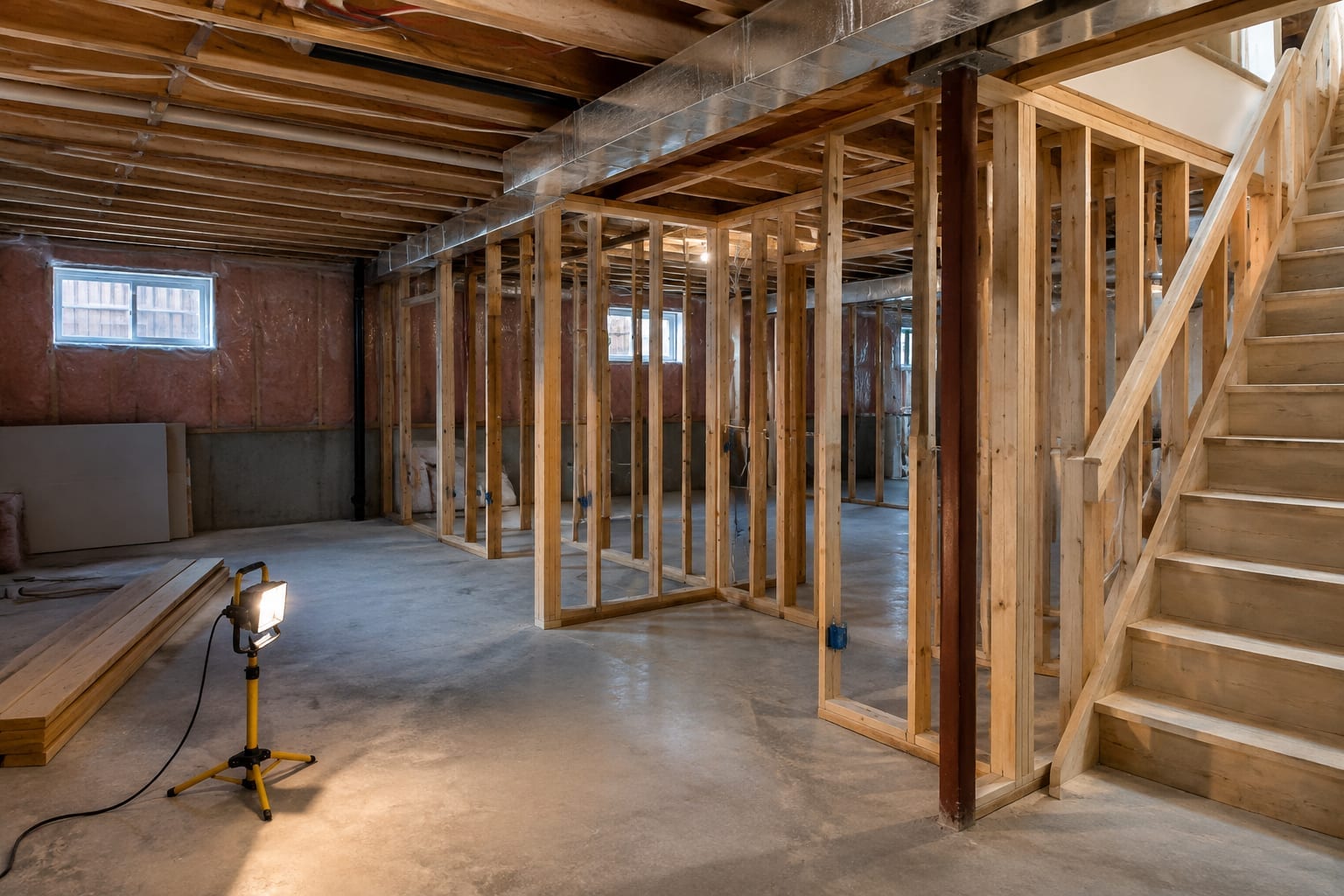 Finishing a basement is one of the projects the City names as needing a permit.
The City's rule of thumb is simple. Under the Building Code Act, a permit is required to build a new building, add to one, or alter any building or structure with a building area over 10 square metres (about 108 square feet). The City's pages walk through the common residential cases: finishing a basement, additions such as sunrooms, attached garages, porches and one or two storey additions, and decks.
Decks have the most specific numbers. A permit is required for a deck attached or next to the house when its walking surface is more than 600 mm (24 inches) above the ground, whatever its size. An elevated deck that gives the main way into the building also needs one. A freestanding deck needs a permit only if it is both larger than 10 square metres and more than 600 mm high. A detached garage, gazebo or pool house under 10 square metres needs no permit, and neither does a one-storey detached storage shed of 15 square metres or less with no plumbing.
The City lists these projects as exempt from a building permit:
- Installing asphalt shingles on a roof, and damp-proofing an existing basement.
- Replacing doors or windows, as long as they go into the same size opening.
- Replacing kitchen or bathroom cabinets, provided the plumbing fixtures stay in the same place. Moving a sink or a toilet takes the job outside that exemption.
- New flooring, painting, decorating and landscaping.
- Installing air conditioning units or heat pumps, or replacing an existing hot water tank.
- Fences that do not enclose a pool (pool enclosures have their own by-law and permit), pool heaters, and decks less than 24 inches above grade, except at a main entrance.
Three warnings go with that list. An exemption from a building permit does not exempt you from the Ontario Building Code or the zoning by-law. Designated heritage buildings and buildings in a Heritage District Overlay are not covered by the exemptions at all, so call a Building Code client service representative first. And electrical work has its own notification, covered below. If you are unsure, the City points residents to 3-1-1 or buildingpermits@ottawa.ca.
How to Apply for an Ottawa Building Permit and What It Costs
 Applications now go through the My ServiceOttawa portal, and emailed applications are no longer accepted.
You can apply online through My ServiceOttawa, using the "Building, planning and land development" service once your account is registered. The City says emailed applications are no longer accepted. In person, Building Code Services counters at City Hall (110 Laurier Avenue West), Ben Franklin Place (101 Centrepointe Drive) and Orleans (255 Centrum Boulevard) are open Monday to Friday, 8:30 am to 4:30 pm. Smaller counters in Metcalfe (Tuesdays), West Carleton (Wednesdays) and North Gower (Thursdays) open one day a week.
A complete application includes the Ontario "Application for a Permit to Construct or Demolish" form and a set of plans, with floor plans, elevations, cross-sections and details. It also needs a property survey or site plan, plus a grading plan where one applies. The City says the Ontario Building Code lets a homeowner take design responsibility for drawings for their own house or for a garage or shed that serves it. If you hire someone to draw plans, Ontario's consumer protection ministry advises checking that they appear in the province's QuARTS public registry before you pay.
The fee for alterations to an existing building is $12.75 for every $1,000 of construction value, with a minimum of $117. Value counts the total of materials, labour, overhead and professional fees. A $60,000 basement finish would therefore carry a permit fee of about $765 (60 x $12.75). Additions that create new floor area are priced from the City's gross floor area schedule instead, and a job that is only plumbing costs $117. Fees are due when you apply.
Do not start early. The fee schedule lists an administrative surcharge of 50% of the permit fee, up to $10,000, when construction begins before the permit is issued.
The City publishes approximate first-review times under its enhanced service level: 5 business days for a basement or a deck, and 10 business days for an addition. That is the first review, not the permit itself, so a request for corrections adds time. Once work starts, book each required inspection about 48 hours ahead. A basement, for example, goes through underground plumbing, plumbing rough-in, framing, insulation and vapour barrier, final plumbing and a final inspection. Skip one and the City may make you uncover the work.
For questions, Building Code Services takes calls at 613-580-2424 (extension 29312). A Development Information Officer can explain zoning rules for your lot by appointment, at extension 23434 or dioinquiry@ottawa.ca, and promises a reply within two to three business days.
Hiring a Home Renovation Contractor: Contract, HST, Deposits and Insurance
 Ontario law requires any home renovation contract over $50 to be in writing.
Ontario's consumer protection ministry gives a clear checklist, and it is worth following to the letter. Get at least three written estimates, and never accept one over the phone or without the contractor inspecting the work area. Ask for three references from people who had similar work done, including some from a few years back, because roofing and paving problems often take a year to show. Search the contractor's business and owner names on the province's Consumer Beware List before you sign.
The contract matters more than the estimate. Under Ontario law, a renovation contract worth more than $50 must be in writing, and it should include:
- The contractor's name, address and contact information, and a thorough description of the work and the materials to be used.
- The total cost, the payment schedule and the deposit amount, along with start and completion dates.
- Any warranties, who handles cleanup, and which sub-trades will be hired and who pays them.
- The estimate itself. If an estimate is part of the contract, the final price cannot run more than 10% over it unless you sign a change that sets a new price.
On money, the ministry recommends a deposit of no more than 10% and never paying the full amount before the work is done. It also tells homeowners to avoid cash deals and, if they do pay cash, to get a detailed signed receipt. In Ontario, HST is 13%, so ask whether each quote includes it or adds it, and look for the rate and the HST amount on the invoice. Some bigger jobs also bring in the Construction Act, which has the person paying on a contract retain a 10% holdback until lien periods run out. Under the Act, a contractor's lien expires 60 days after the contract is completed, unless it has been preserved. For a major job, the ministry suggests having a lawyer read the contract first.
If you sign a contract worth $50 or more in your own home, you have a 10-calendar-day cooling-off period and can cancel for any reason without a fee. If work has started in that window, you owe reasonable payment for the work and materials already supplied. This is also where door-to-door pitches go wrong, so read our guide to door-to-door construction scams in Ottawa and our overview of common scams in Ottawa.
Two more checks protect you from injury and unpaid bills. The first is WSIB coverage. Ontario says workers and independent operators in construction must have workplace safety insurance, with some exceptions, and the WSIB lets you search a business by name through its online services. A clearance certificate is the proof a business is up to date. The WSIB says no clearance is required when a home's resident hires a contractor for repairs or renovations, but a general contractor who hires subcontractors must get clearances from them. The second check is liability insurance. It is sensible to ask for a certificate of insurance showing general liability cover and to phone the insurer to confirm it is current. Also tell your own home insurer about a large renovation.
Permits are another point to settle in writing. The ministry says it is your responsibility to get building permits, so if you want the contractor to get them, say so in the contract and do not let construction begin until you have seen them. Browse the Home Renovation directory page to find local listings, then run each name through the checks above.
Hiring an Electrician or Plumber for Home Renovation Work in Ottawa
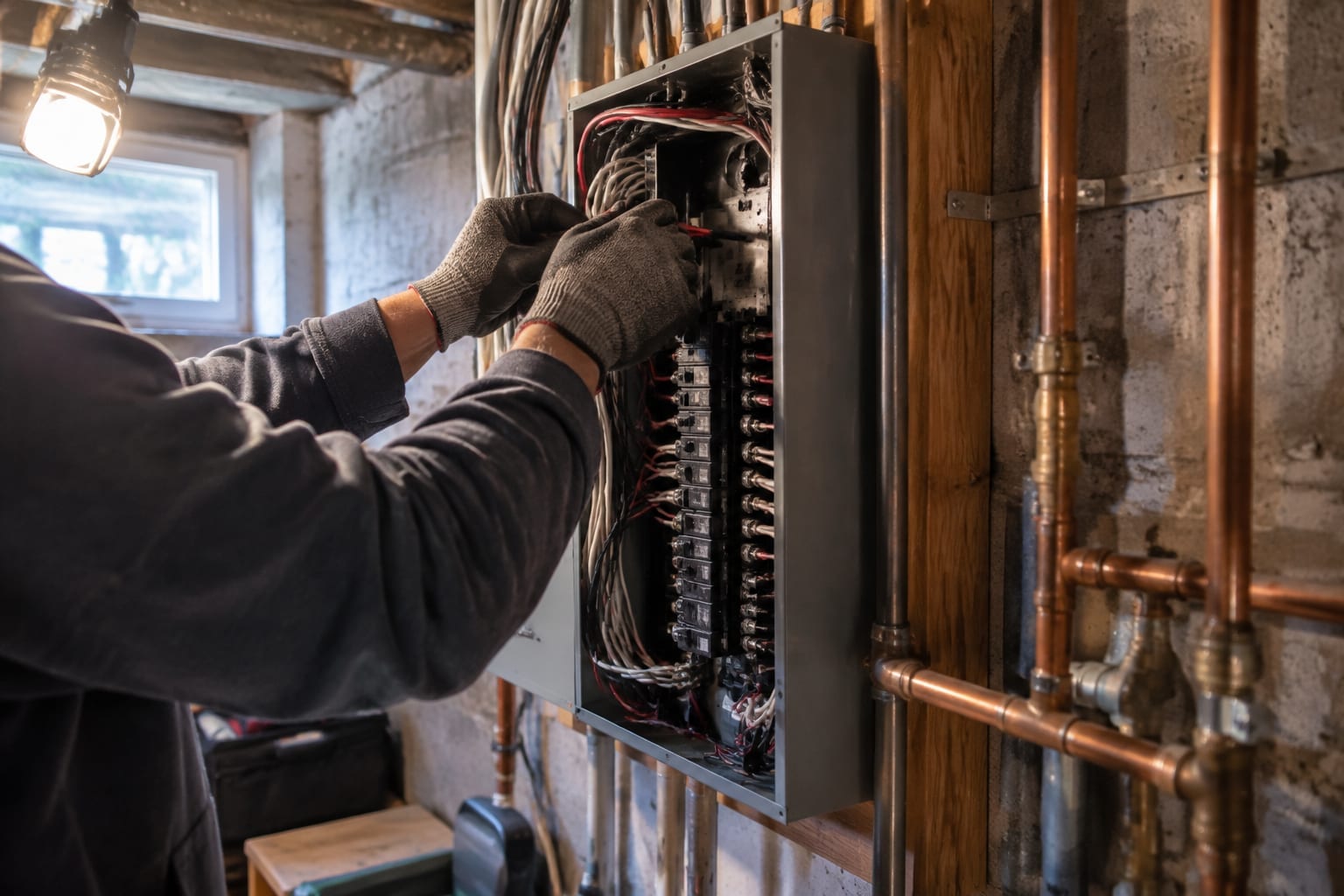 Both trades are licensed in Ontario, and each has a way for you to check a name.
Electrician. The Electrical Safety Authority (ESA) says that if you hire someone to do electrical work in your home, by law it must be a Licensed Electrical Contractor. That is a business, and it holds an ECRA/ESA licence number. Master or certified electricians work for these businesses but cannot be hired directly. Ask for the licence number, look for it on the truck, the business card and the estimate, and confirm it on ESA's Find a Contractor tool.
Almost all electrical work must be reported to ESA through a notification of work, which works like a permit. The contractor should file it before work starts, and ESA says a building permit is not the same thing, so you may need both. When the work passes review, ESA issues a Certificate of Acceptance, which insurers may ask for and which can matter at resale. ESA lists red flags: no licence number, a request that you pull the ESA permit yourself, a cash discount with no receipt, or a line like "if anyone asks, tell them you did it yourself." With a general contractor, ask who the electrician is, and make sure a licensed electrical contractor files the permit. ESA says the electrical work needs its own permit, separate from the building permit.
Plumber. Plumbing is a compulsory trade in Ontario. To work legally, a plumber must hold a Registered Training Agreement, Provisional Certificate of Qualification or Certificate of Qualification, and their name must appear on the Skilled Trades Ontario Public Register. Asking for that is reasonable, and Ontario's consumer ministry also suggests asking whether tradespeople are certified through Skilled Trades Ontario.
The City adds its own layer. A job that is only plumbing carries a $117 permit fee. In a finished basement, the City's inspections include underground plumbing and plumbing rough-in, and both are tested, then a final plumbing inspection. Replacing an existing hot water tank is on the permit-exempt list, but for anything that adds or moves plumbing, ask the City first. Our guide to frozen pipes and plumbers in Ottawa covers emergency call-outs, and the directory has pages for electricians and plumbers. Check each name against the registers above, not just the listing.
Heritage Homes and Committee of Adjustment Cases
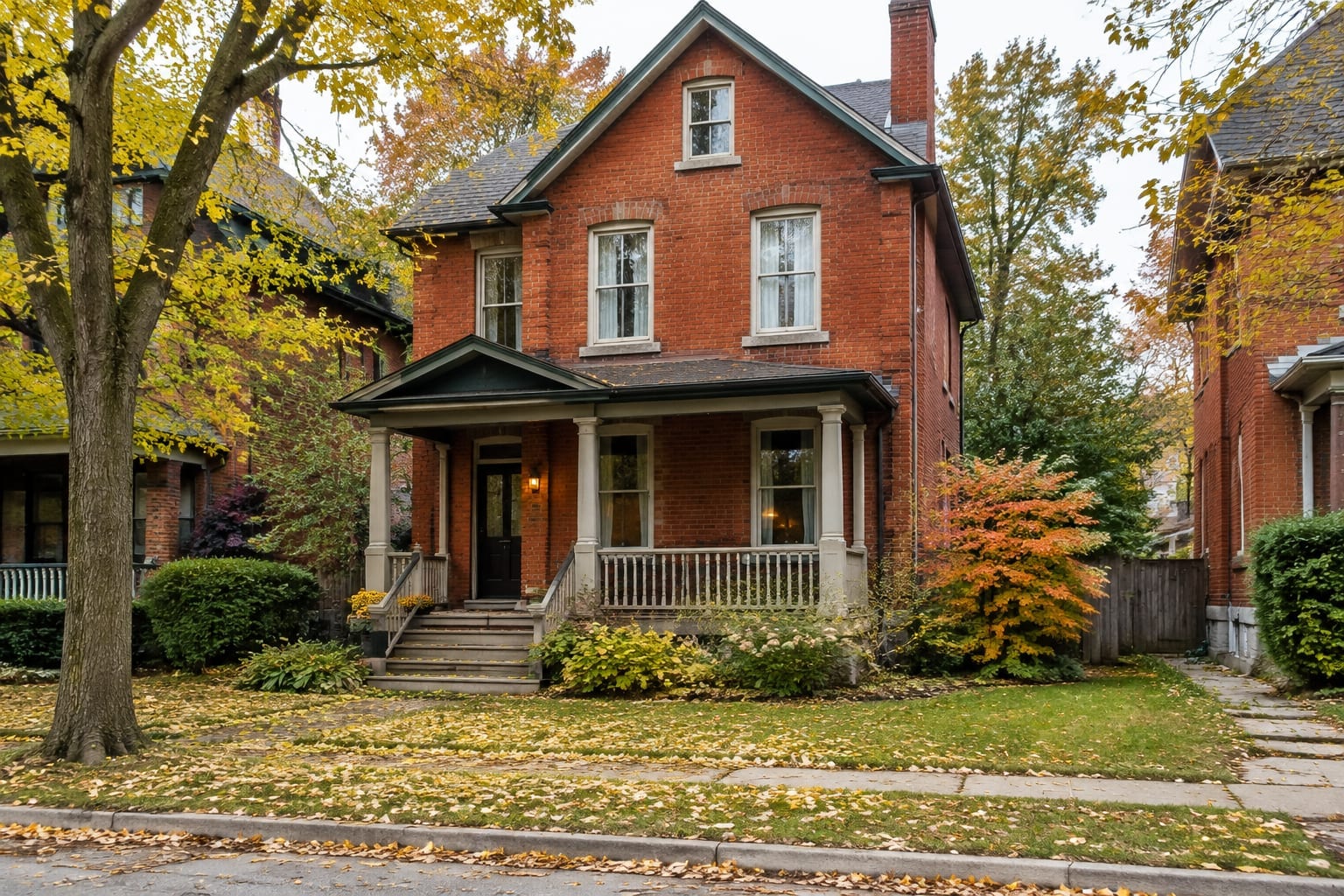 In a heritage conservation district, even replacing windows or a porch needs City approval first.
Two approvals sit outside the building permit, and both can add months. The first is a heritage permit. Under the Ontario Heritage Act, alterations to a designated heritage property, or to any property in a Heritage Conservation District, need the City's approval. The City names additions, window replacement, partial demolition, and porch replacement or restoration. Approval must come before work that touches heritage features, and it does not replace a building permit. To check a property, turn on the "Heritage" layer under "Planning" in the City's geoOttawa map, or contact Heritage Planning at heritage@ottawa.ca or 613-580-2463.
Fees depend on the scale of the work. On its Changes to heritage properties page, the City lists $309 for a staff-level alteration such as a window replacement or porch change, and $927 for a small addition. Council-level applications run $2,799 for a minor alteration and $10,093 for a major one. Restoration, maintenance and landscaping projects processed by staff carry no fee. Another City page shows lower staff-level amounts ($279 and $837), so confirm the figure with a heritage planner first. Applications for Part IV designated properties need a sworn declaration, and the City provides a Commissioner of Oaths for heritage applications free of charge. A refusal or the conditions can be appealed to the Ontario Land Tribunal within 30 days.
The second is the Committee of Adjustment. If your plan does not meet the zoning by-law, such as a rear addition that is too close to a lot line, you can apply for a minor variance. As of November 21, 2025, a provincial regulation lets owners reduce a zoning setback by 10% as of right, so a small shortfall may not need a hearing. The City also notes that two zoning by-laws are now in effect, so ask a Development Information Officer which one applies to your lot.
Cost and time are real. The City's fee schedule, in effect since January 1, 2026, puts the total fee for a minor variance at $3,759 or $4,064, depending on whether the property falls in its urban or rural table. Staff check completeness within three business days, a hearing date is not assigned until the application is complete, and processing a complete file can take up to 10 business days. Applications become public, and the City encourages you to talk to neighbours and your community association first. Contact the Committee at 613-580-2436 or cofa@ottawa.ca.
Energy Rebates and Loans for Home Renovation in Ottawa Right Now
 Attic insulation is one of the upgrades with a rebate that does not need a home energy assessment.
Programs change faster than renovation schedules, so each one below was checked against its own site when this guide was written.
Home Renovation Savings (Ontario): open. This program from Save on Energy and Enbridge Gas, supported by the Ontario government, has two routes. The assessment route starts with a registered energy advisor's home energy assessment before any work begins. You then complete at least two upgrades, and a third earns an extra $500. Rebates include up to $1,500 for attic insulation, up to $3,600 for exterior wall insulation, $100 per rough opening for ENERGY STAR windows and doors, $500 for a heat pump water heater and up to $250 for air sealing, plus $600 toward the assessments. The no-assessment route covers heat pumps (up to $12,000), solar and storage (up to $10,000), attic insulation (up to $1,250), smart thermostats and appliances.
You must own the home, which must be a detached, semi-detached, row or townhouse or a mobile home on a permanent foundation. Heat pump rebates depend on your home's primary heating source. The program's pages show no end date, but some third-party guides claim it ends on November 30, 2026. I could not confirm that, so check the terms and book the assessment before you sign a contractor.
Better Homes Ottawa Loan: taking enrolments. The City's loan is for energy upgrades. It runs 20 years at a fixed 4.33%, with a 4% administration charge, for $10,000 up to the lesser of $125,000 or 10% of the home's assessed value. Repayment appears on your property tax bill and stays with the property if you sell. An EnerGuide assessment is required, and only costs after your Notice to Proceed qualify, so do not start work first. Participants can also get a City heat pump incentive of $700 per ton for cold-climate air-source models. Gas furnaces and water heaters are not funded.
Federal programs: mostly closed. Natural Resources Canada lists the Canada Greener Homes Loan as closed, with funding fully committed and new applications unable to be approved. Its Greener Homes Grant page also shows as closed. The Canada Greener Homes Affordability Program offers no-cost retrofits to low-to-median-income homeowners and tenants through provincial partners, but the provinces listed as accepting applications on August 31, 2026 did not include Ontario. Treat any caller or door-knocker who claims to represent these programs with suspicion: NRCan says it never solicits by phone, email or door to door.
One last rule from Ontario's consumer ministry: if a contractor says your job qualifies for a rebate, confirm it yourself with the program. The responsibility is yours.
Timing a Home Renovation Around Ottawa Winters
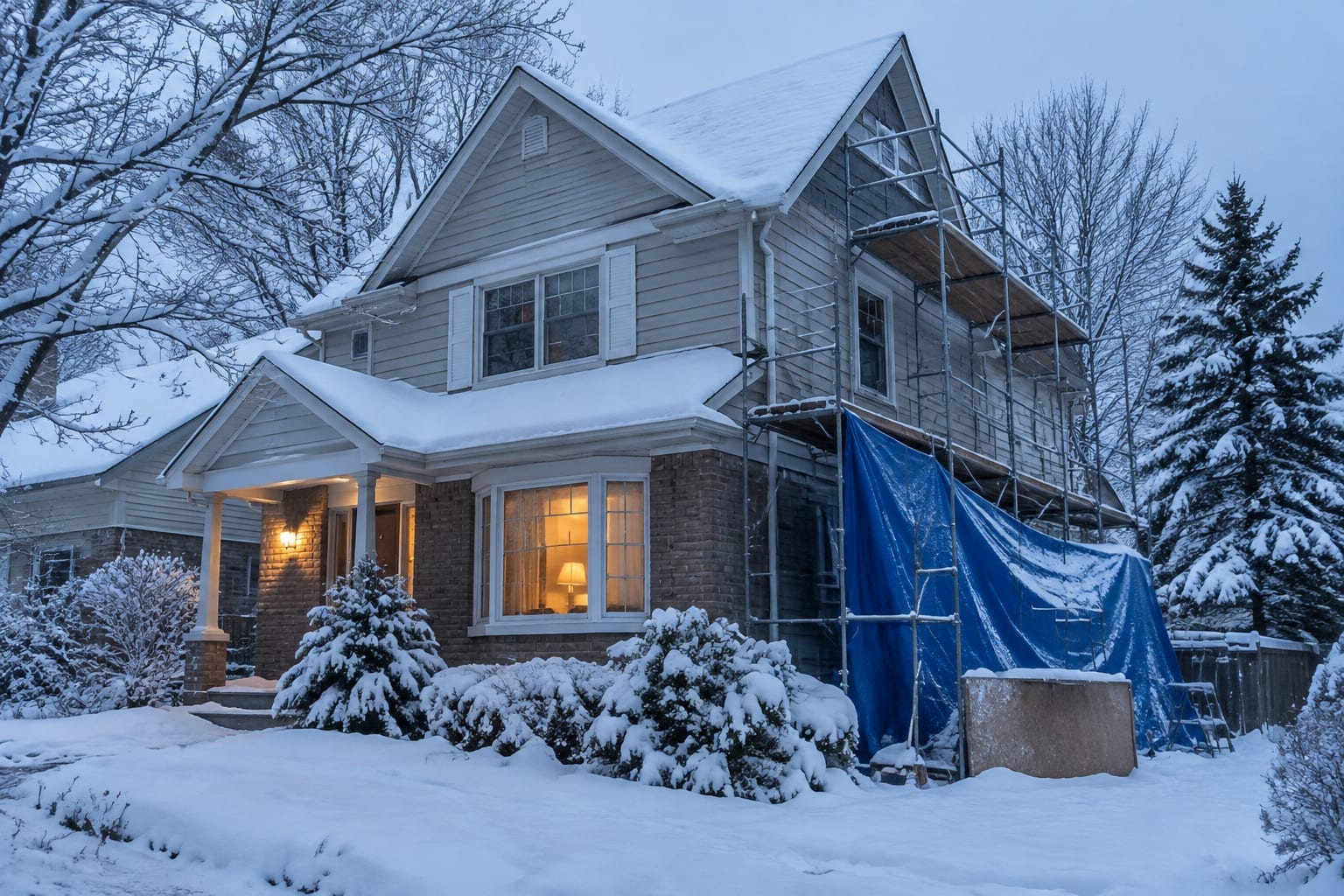 Interior projects keep moving in January, while exterior work usually waits for warmer weather.
Plan around the weather, then use the cold months for the paperwork. The City's first review of a permit takes business days and longer if it asks for corrections, and the assessment route of Home Renovation Savings needs an energy assessment before any work starts. Applying for permits in November or December, with quotes in hand, lets exterior work begin when the ground thaws. Inside, basement finishing, kitchens, bathrooms and flooring carry on through winter, though inspections still need 48 hours' notice.
Some exterior jobs are harder in the cold. The Asphalt Roofing Manufacturers Association says asphalt shingles can be installed in cold climates but become less flexible as it gets colder, and may crack when handled. It also warns about nearly invisible frost on roof decks. The association advises following the manufacturer's cold-weather instructions and suggests hand-sealing in very cold weather. Ask a roofer or paving contractor how they handle the cold, and what the contract says about weather delays.
A winter job also needs a plan for the house itself. Pipes, windows and exterior walls that are opened up need to stay protected from freezing, and our winter preparedness guide for Ottawa and frozen pipes guide cover the basics. If a renovation will leave part of the house without heat, tell your contractor and your insurer before work starts.
FAQ
Q: Do I need a permit to renovate my kitchen or bathroom in Ottawa?
Not always. The City exempts replacing cabinets as long as plumbing fixtures stay put, plus new flooring and painting. Moving fixtures, changing plumbing or altering walls is a different job, so ask 3-1-1 or buildingpermits@ottawa.ca. Electrical changes also need an ESA notification, which is separate from the building permit.
Q: How much does a building permit cost in Ottawa?
For work on an existing building, the City charges $12.75 per $1,000 of construction value, with a $117 minimum, payable when you apply. A job that is only plumbing costs $117. New floor area, such as an addition, uses the City's gross floor area schedule instead. Starting before the permit is issued adds a 50% surcharge, up to $10,000.
Q: How much deposit should I pay a contractor in Ontario?
Ontario's consumer protection ministry recommends no more than 10% and says never to pay the full amount before the work is done. Get everything in a written contract, avoid cash deals, and keep detailed receipts. If a salesperson pushes you to sign at your door, remember the 10-day cooling-off period for contracts signed in your home.
Q: Can I hire an electrician directly in Ontario?
You can hire a Licensed Electrical Contractor, which is a business with an ECRA/ESA licence number. Individual master or certified electricians cannot be hired directly for work in your home. The contractor files the ESA notification of work before starting and arranges inspection. Verify the licence number on ESA's Find a Contractor tool before you sign.
Q: Are federal energy rebates still available in Ottawa?
Mostly no. Natural Resources Canada lists the Canada Greener Homes Loan as closed, and its grant page also shows closed. Ontario's Home Renovation Savings program and the City's Better Homes Ottawa Loan are open on their own sites today. Check each program's current rules before you sign a contract.
Q: Does a heritage house need a different permit?
Yes. Alterations to a designated heritage property, or one in a Heritage Conservation District, need heritage approval from the City, and it does not replace a building permit. Window replacement and porch work are on the City's list. Contact Heritage Planning at heritage@ottawa.ca or 613-580-2463 before you plan.
Final Thoughts
A good Ottawa home renovation is mostly decided before the work begins. A permit check takes minutes on the City's pages, a written contract with a capped deposit takes an afternoon, and an energy assessment booked ahead of the contractor can be worth thousands of dollars in rebates. The costly mistakes tend to come from skipping a step: starting before a permit, paying cash to an unlicensed electrician, or signing a contract before a rebate is confirmed.
Use the City, ESA, Skilled Trades Ontario and WSIB lookups to check any name you are given. The Home Renovation directory page is a place to start the search, but it draws on OpenStreetMap data, so confirm each business yourself.
Source: City of Ottawa, Do I need a building permit?
Source: City of Ottawa, Projects not requiring building permits
Source: City of Ottawa, Comprehensive Building Code Fee Schedule (January 1, 2026)
Source: City of Ottawa, Changes to heritage properties
Source: City of Ottawa, Committee of Adjustment: apply for a minor variance and application fees
Source: Ontario, Your rights when starting home renovations or repairs
Source: Electrical Safety Authority, Notifications and Inspections
Source: Home Renovation Savings program
Source: Better Homes Ottawa Loan Program